USD
USD  GBP
GBP  CAD
CAD  INR
INR  AUD
AUD  SGD
SGD 



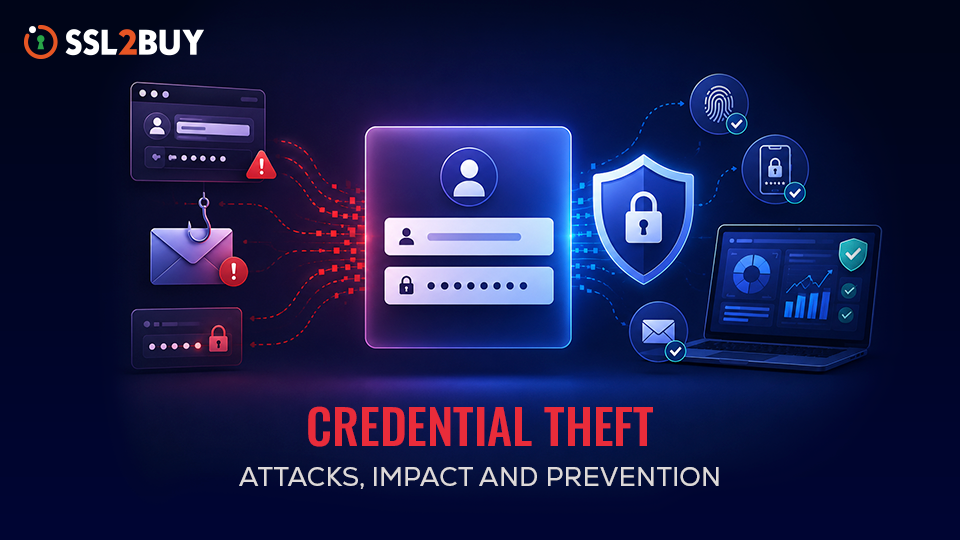
Stolen Credentials Have Become the Biggest Entry Point for Modern Cyberattacks
Almost every system today, including cloud platforms, SaaS tools, and enterprise apps, relies on identity to control who gets in. That shift has made login credentials one of the most valuable things an attacker can get their hands on. A single compromised account can be enough to move through an entire network, access sensitive data, and stay hidden for weeks without triggering an alarm.
Credential theft is often how ransomware gets deployed, how business email compromise happens, and how data ends up for sale on dark web forums. [1] According to the 2025 Verizon Data Breach Investigations Report, stolen credentials are one of the top breach entry points, involved in over 1 in 5 attacks.
This blog breaks down how credential theft actually works, why it’s so hard to catch, and what practical steps can meaningfully reduce the risk.
What is Credential Theft?
The unauthorized acquisition of authentication information that enables an attacker to access systems as if they were a genuine user is known as credential theft. Here, login details are not the only type of credentials. They include:
- Usernames and passwords
- Session tokens and browser cookies
- API keys and private keys
Once an attacker obtains any of these, they no longer need to “break in.” They can simply log in. The objective is straightforward. Impersonate legitimate users and maintain access without raising suspicion. This is what makes credential theft dangerous. It blends into normal activity instead of triggering obvious alarms.
This shift is why identity has effectively become the new security perimeter. It is no longer just about protecting systems, it is about protecting who can access them.
Why Credential Theft Is So Effective
Stealing credentials is significantly more effective from the standpoint of an attacker than taking advantage of security flaws. Attackers can get beyond conventional security measures by using credentials that have been stolen. Intrusion detection systems, firewalls, and endpoint security are frequently made to prevent unauthorized access. Credentials make it appear authorized.
The problem becomes worse due to credential reuse. A password compromised on one platform is often valid across multiple services. This creates a chain reaction of compromise.
Once inside, attackers elevate access and escalate privileges by moving laterally across systems. Complete network control can appear from a single compromised account.
There is also a thriving underground economy where stolen credentials are bought and sold in bulk. This industrializes credential theft and makes attacks scalable.
Weak Credential Practices That Enable Attacks
Credential theft is not just an attacker problem. It is often enabled by weak practices.
Common issues include:
- Short and predictable passwords
- Reusing the same password across multiple accounts
- Using personal or publicly available information
- Pattern-based passwords like “Company@123”
It’s not just about creating passwords, how they’re stored matters too. Saving credentials in plain text, sharing them over unsafe channels, or not rotating privileged ones can increase risk a lot.
These weaknesses reduce the effort required for attackers. In many cases, they do not need sophisticated techniques. Basic guessing or reuse is enough.
Common Ways Credential Theft Happens
Here are some of the common ways attackers make credential theft alive:

Social Engineering Attacks
Social engineering isn’t really about breaking into systems, it’s about getting people to open the door themselves. A common example is phishing, where fake login pages are designed to look convincing enough that users hand over their credentials without thinking twice, something that played out in breaches like Anthem Inc [2].
Then there’s spear phishing, which goes a bit further. Instead of generic emails, attackers shape messages using real context. That makes them feel more legitimate, especially in areas like healthcare where people rely a lot on trust.
Executive impersonation is another angle, where attackers pretend to be someone in leadership and push for urgent actions, often financial. Incidents like the one involving Levitas Capital [3] show how effective this can be when people don’t question authority at the right moment.
Malware-Based Credential Theft
Malware operates silently on compromised systems.
- Keyloggers capture everything typed
- Spyware extracts stored browser credentials
- Trojans provide persistent remote access
Advanced techniques include memory scraping and credential harvesting directly from browsers.
Automated Attack Techniques
Automation enables attacks at scale.
- Brute force attacks – Systematically guessing passwords
- Credential stuffing – Using leaked credentials across platforms. The Okta breach started this way, with attackers using credentials stolen from a third-party vendor [4].
- Password spraying – Trying common passwords across many accounts
These attacks are powered by bots and massive credential dumps available on dark web markets. The Colonial Pipeline attack, which disrupted fuel supply across the US East Coast, began with a single leaked VPN password, no MFA was enabled on that account [5].
Exploitation of System and Application Weaknesses
Vulnerabilities often act as entry points.
- Unpatched systems and outdated software
- Insecure application design
- Database exposure and misconfigurations
Techniques like SQL injection remain a major vector for pulling credentials out of poorly secured databases. The OWASP report lists injection attacks among the most critical risks facing web applications, and misconfigurations in cloud storage have exposed hundreds of millions of credential records in the last few years alone [6].
Session and Token Hijacking
In some cases, attackers bypass passwords entirely.
- Stealing session cookies
- Intercepting tokens via man-in-the-middle attacks
This allows persistent access even if the password is changed, making detection harder.
Why Most Credential Theft Starts in the Inbox
Email remains the primary entry point for credential theft.
Phishing attacks take advantage of trust, urgency, and familiar brands. A well-written email can easily push users to fake login pages or make them download something harmful.
Email isn’t just for sending messages. It is linked to user identity. If there are gaps in authentication or sender checks then attackers can take advantage of that. That’s how they manage to impersonate trusted brands and still look convincing.

Prevention Techniques for Credential Theft
Layered controls, compared to a single solution are necessary to prevent credential theft.
-
Adopt strong authentication
If there’s an option to enable multi-factor authentication, it’s usually worth taking. Not all MFA is equal though, hardware keys or biometrics tend to hold up much better against phishing compared to basic OTPs. And when MFA just isn’t possible for some reason, it still helps to add a few basic checks like rate limiting or CAPTCHA. They’re not perfect, but they make automated attacks much harder to carry out at scale.
-
Enforce credential hygiene
Encourage long, unique passphrases instead of simple passwords. Eliminate reuse and rely on password managers for secure storage. Monitoring leaked credential databases can provide early warning signals.
-
Implement least privilege access
Restrict user rights to what is required. For critical jobs, use just-in-time access to limit the damage even in the event that credentials are hacked.
-
Secure storage and transmission
Passwords should never be saved in plain text. Always use hashing and salting to protect them. Also, make sure data is encrypted while it’s being sent. API keys and machine credentials should be secured just like user passwords.
-
Keep systems updated
The attack surface is decreased by routine patching. Operating systems, apps, and third-party dependencies fall under this category.
-
Monitor and detect threats
Track login anomalies, detect impossible travel scenarios (a user logging in from Mumbai and Chicago within the same hour), and set up alerts for suspicious behavior. Identity-focused monitoring is critical because attackers use valid credentials — without it, there’s nothing to distinguish them from legitimate users.
-
Strengthen the human layer
Security awareness needs to go beyond simple phishing detection. Users must comprehend context, confirm strange requests, and promptly report any questionable actions.
-
Secure endpoints
Endpoints are often where credentials are captured. Use endpoint protection, restrict unauthorized software, and monitor device-level activity.
-
Harden recovery mechanisms
Password reset flows should use secure, time-bound tokens. Avoid weak security questions and monitor for abuse in recovery processes.

Building a Security-First Culture
Credential theft cannot be prevented by technology alone. In this case, user behavior is crucial. Employees must be aware that even requests for access that appear to be valid may be fraudulent.
Security must be emphasized by leadership as a top concern rather than an afterthought. Building systems and procedures where safe behavior is the norm. When verification is easy and expected, risk reduces naturally.
Conclusion
Credential theft works so well because attackers don’t bother breaking systems when they can just log in as someone. And stopping that is not just about asking people to use better passwords. You need a mix of things in place such as stronger authentication, visibility into what’s happening, people who know what to watch out for, and systems that are not easy to misuse. As security shifts more toward identity, protecting credentials is not just one part of the problem.
References: