USD
USD  GBP
GBP  CAD
CAD  INR
INR  AUD
AUD  SGD
SGD 


Business Email Compromise and the Breakdown of Digital Identity
Business Email Compromise is often discussed as an email security problem. Something to be solved with better filters, stronger phishing detection, or tighter domain controls. That framing misses the real issue. BEC succeeds because businesses treat email identity as a trusted signal for decision-making. A familiar name implies authority. A known role implies intent. Once those assumptions are accepted, attackers no longer need malware or technical exploits to cause real damage.
This blog looks at Business Email Compromise (BEC) through that lens. Not as a failure of email technology, but as a failure of how digital identity is assumed and applied inside business workflows. It explains why BEC attacks rely on legitimate-looking emails rather than malicious ones. How BEC emails exploit gaps between identity and intent, and why strengthening identity models is central to reducing BEC risk.
What is Business Email Compromise?
Business Email Compromise is a form of fraud where attackers impersonate trusted business identities to manipulate recipients into taking legitimate actions for illegitimate purposes. Rather than exploiting technical weaknesses in email infrastructure, BEC attacks target humans and procedural layers. The email itself is not malicious, but the request appears routine and contextually valid.
BEC attacks succeed by exploiting how organizations assign authority and intent based on email identity. When a message appears to come from a known executive, vendor, or internal function, it is often treated as a trusted instruction rather than a request requiring verification. This assumed legitimacy allows BEC emails to bypass traditional security controls that focus on detecting malware, links, or attachments.
A typical BEC flow is simple. An attacker observes internal communication patterns, who reports to whom, how money moves, and how vendors are paid. They impersonate a known identity, usually an executive, finance staff, or vendor. They send a request that fits the ongoing business context. The recipient complies because the request appears authentic.
Trust failure happens at several points. The sender identity is assumed valid. The role is assumed to be authoritative. The request is assumed to align with normal operations. At no point is intent independently verified before action is taken.
BEC attacks do not depend on malware. Instead, attackers use legitimate-looking email identities obtained through account compromise, domain spoofing, or display-name impersonation. Because BEC emails appear operationally routine and technically clean, they evade detection while still carrying high authority within business workflows.
How BEC Emails Differ from Traditional Phishing
- BEC emails rarely include malicious links or attachments
- Messages are sent from real or look-alike domains
- Requests align with active financial or operational workflows
- The goal is action, not interaction or credential harvesting
- AI-Driven Sophistication: By 2026, generative AI is a standard tool for attackers to create grammatically perfect, voice-cloned, or highly personalized messages that bypass traditional filters.
- Financial Loss: BEC remains the costliest cybercrime, with cumulative global losses reported over $55 billion over the past decade.
- Success Rate: BEC attacks accounted for roughly 73% of all reported cyber incidents in 2024, continuing to be a dominant threat into 2026.
How Business Email Compromise (BEC) Works?
BEC attacks follow a predictable execution flow, although the identities and scenarios may vary.

Reconnaissance
Attackers study the organization’s structure, vendors, and financial workflows using public information or prior email access.

Identity Selection
A trusted identity is chosen – typically an executive, finance role, or vendor, based on its ability to trigger action.

Context Message Crafting
The request is designed to match an active business process, using familiar tone, timing, and operational details.

Impersonation or Access
Emails are sent using spoofed domains, compromised accounts, or display-name impersonation to appear legitimate.

Action and Delayed Detection
Funds are transferred, details are changed, or data is released. The fraud is typically discovered only after reconciliation or third-party follow-up.
Common Types of Business Email Compromise (BEC) Attacks
While all BEC attacks exploit trust in email identity, they typically fall into repeatable patterns based on the business function being targeted.
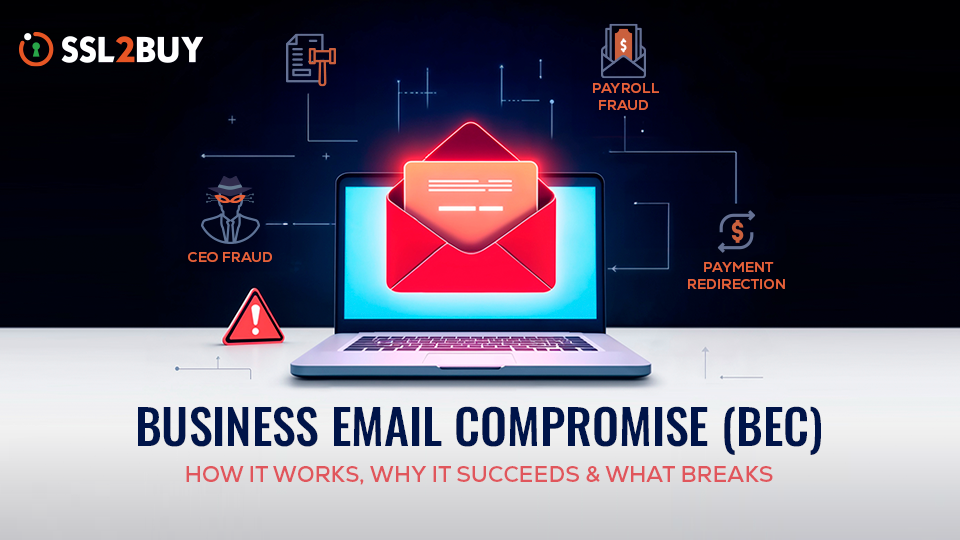
Executive Impersonation (CEO Fraud)
Attackers impersonate senior leadership to create urgency around wire transfers, confidential requests, or emergency approvals. Authority and time pressure suppress verification.
Scenario: A “CEO” asks an assistant to buy gift cards or wire funds urgently.
Vendor Payment Redirection
BEC scams targeting accounts payable workflows by altering banking details during invoice processing or payment confirmation cycles.
Scenario: A fake email from a vendor requests new bank details for payments.
Payroll and HR Fraud
Attackers request changes to direct deposit information or attempt to harvest tax and employee data using trusted internal identities.
Scenario: An internal email asks HR to update an employee’s direct deposit information ahead of payroll processing.
Legal and M&A Impersonation
These BEC attacks exploit confidentiality norms and reduced scrutiny during mergers, acquisitions, audits, or legal proceedings.
Scenario: A fake lawyer demands immediate payments or sensitive info.

How Business Email Compromise Exploits Digital Identity
Digital identity in a business context is broader than authentication. It includes names, roles, email addresses, domains, writing style, and historical behavior. These signals combine to form perceived legitimacy.
Email identity acts as a proxy for trust. If an email appears to come from a known person at a known domain, it is often treated as authoritative. The system does not confirm intent. It confirms delivery.
Attackers exploit weak identity signals. Display names are easy to spoof, and domains can be visually similar. Reply chains can be hijacked, and once an attacker fits into the expected context, scrutiny drops sharply.
Organizations rely heavily on assumed legitimacy. A familiar name. A senior title. A request that matches quarterly pressure. These assumptions replace verification. Email is treated as proof of identity because it has historically worked that way. It is auditable, persistent, and tied to organizational directories. That legacy trust has now become a liability.
BEC succeeds because digital identity in email lacks a strong binding between sender, intent, and action.
Why Traditional Email Security Misses BEC Attacks
Traditional email security is designed to detect malicious content such as links, attachments, or known indicators of compromise. Business Email Compromise (BEC) attacks succeed by avoiding these signals entirely. Here’s what they miss:
Lack of Technical Indicators
Most email security tools look for malicious links, attachments, or known indicators of compromise. BEC emails rarely include any of these. They are often technically clean and may originate from legitimate accounts or trusted domains, leaving nothing obvious to block without disrupting real business communication.
Social Engineering and Trust Exploitation
BEC attacks rely on authority, urgency, and familiarity rather than deception at the technical layer. Requests are framed to match routine business operations, compressing decision time and discouraging verification. Recipients act not because they are careless, but because the request aligns with how email is expected to function inside the organization.
Identity and Context Manipulation
Attackers succeed by fitting seamlessly into existing workflows. They mirror tone, timing, and internal context, referencing real people and processes. Once an email aligns with expected patterns, identity ambiguity goes unchallenged. Traditional email security validates delivery and access, but not whether the sender is authorized to request a specific action at that moment.
Real-World Impacts of Business Email Compromise
Financial Exposure
The most immediate impact of Business Email Compromise is financial loss, but the broader damage often unfolds over time. Because BEC attacks exploit legitimate workflows, losses are rarely detected at the moment they occur. Funds are transferred, payment details are changed, or data is released under the assumption that the request is valid.
Delayed Detection
In vendor payment scenarios, organizations continue processing invoices until a supplier reports missing funds. In executive impersonation attacks, urgency and authority suppress verification, allowing transfers to be approved without challenge. By the time discrepancies surface, recovery options are limited.
Operational Disruption
Beyond direct losses, BEC attacks disrupt core business operations. Finance teams pause payments, approval processes slow down, and emergency controls are introduced under pressure. Trust in routine email-based workflows erodes, affecting procurement cycles, vendor relationships, and internal productivity.
Reputational and Compliance Impact
Partners and auditors scrutinize how identity-based decisions are made, while regulated organizations may face disclosure obligations or governance reviews. What initially appears to be a single fraudulent transaction often exposes deeper weaknesses in approval models and identity assumptions.
Structural Trust Breakdown
BEC incidents reveal structural gaps that existed long before the attack. Informal authorization paths, reliance on email as proof of intent, and identity checks enforced inconsistently across teams all become visible. The damage extends beyond what was stolen to the effort required to rebuild trust in everyday business communication.

Prevention Techniques for BEC Attacks
- BEC prevention starts by validating authority, not just sender authenticity. High-risk actions should require stronger identity assurance than routine communication.
- Sensitive requests should never rely on a single email for approval. Independent verification removes single-point trust failures without slowing normal workflows.
- SPF, DKIM, and DMARC reduce domain spoofing and establish baseline sender legitimacy. These controls raise the cost of impersonation but do not eliminate BEC on their own.
- BEC attacks often break normal behavior patterns rather than technical rules. Monitoring timing, recipients, and request context helps surface risk that content-based controls miss.
Final Thoughts
Business Email Compromise does not break systems. It breaks assumptions. Attackers exploit the gap between who an email appears to be from and who is actually making the request. As long as email identity is treated as proof by default, BEC will continue to scale. Moving from trust-by-default to verify-by-design requires rethinking identity at the workflow level. Not just who logged in, but who is asking, for what, and under what context. Identity assurance is not an email feature. It is a business control.