USD
USD  GBP
GBP  CAD
CAD  INR
INR  AUD
AUD  SGD
SGD 


PGP Encryption Protects Business Email Content Beyond Standard Security
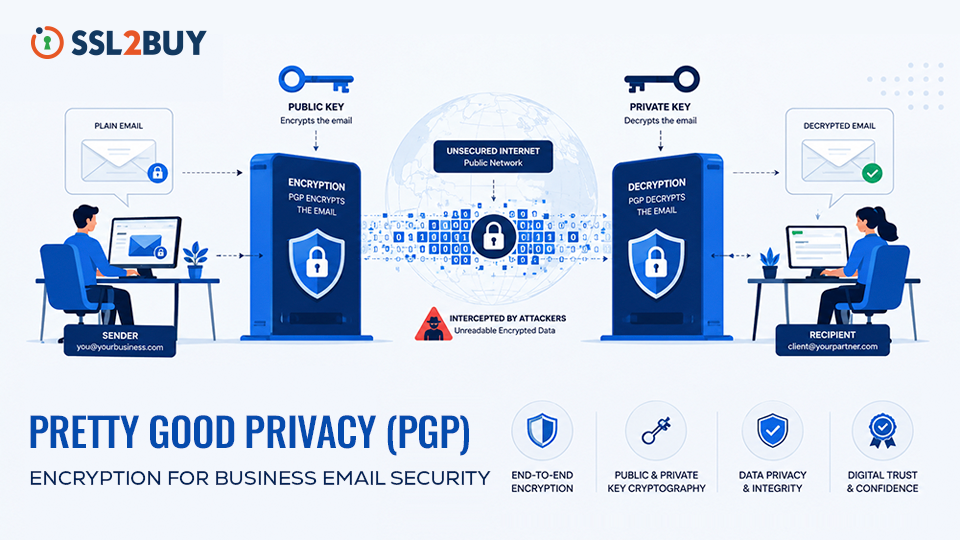
PGP encryption is a standard that works like a digital lockbox; it scrambles messages, files, and stored data completely, so that even if someone intercepts it, steals it from a server, or pulls it from a breached mailbox, all they get is unreadable data. Only the person holding the right private key can open it.
This level of protection has become a critical defense for organizations, especially since Business Email Compromise (BEC) attacks caused more than $2.9 billion in reported losses according to the FBI’s Internet Crime Complaint Center. Because standard email was never built for absolute secrecy, relying on transport-layer encryption alone leaves sensitive corporate data deeply exposed.
Here is a practical look at how PGP works, what it protects, and how businesses can implement it securely.
What is PGP Encryption?
PGP was created by Phil Zimmermann back in 1991 to provide strong encryption and privacy in digital communication, mostly for emails. The main idea was to make sure only the correct person can read the message and nobody else in between can understand it.
The Three Types of PGP: PGP vs. OpenPGP vs. GPG
- PGP – commercial product: The proprietary implementation that eventually became part of Broadcom through acquisition chains.
- OpenPGP: The open encryption standard defined under IETF RFC 9580, which specifies how compatible systems should operate.
- GPG – GNU Privacy Guard: The open-source implementation most organizations and technical users actually deploy today.
In real business use, when companies say they are using PGP encryption, many times they are actually using GPG or some other platform that supports the OpenPGP standard.
Because OpenPGP is not under the authority of a single business or provider, many tools, email clients, and corporate systems may collaborate without being restricted to a single ecosystem.
How PGP Encryption Works
PGP encryption works by combining two types of encryption — symmetric and asymmetric — into a single hybrid model. This means the message itself is encrypted quickly using a session key, and that session key is then secured using the recipient’s public key. Only the recipient’s private key can unlock it.
The process works like this:
- PGP generates a random session key and uses it to encrypt the message content
- The session key is encrypted with the recipient’s public key
- The recipient uses their private key to decrypt the session key
- The decrypted session key unlocks the actual message
The hybrid encryption model allows secure key exchange without transmitting secret decryption material openly. PGP also supports digital signatures for integrity verification and sender authentication.
When signing a message:
- The sender generates a SHA-256 hash of the content
- The hash is encrypted using the sender’s private key
- The recipient verifies the signature using the sender’s public key
Most deployments rely on RSA-based cryptography because of compatibility and ecosystem support, though Diffie-Hellman and DSS variants are also supported in some implementations.
What Does PGP Encrypt? (Capabilities and Limitations)

PGP provides strong protection for email content, but it is not total communication invisibility.
PGP encrypts:
- Message bodies
- Attachments
- Stored encrypted archives and transferred files
However, some metadata remains exposed because mail routing still depends on it.
PGP does not encrypt:
- Subject lines
- Sender addresses
- Recipient addresses
- Timestamps and routing headers
Because metadata remains exposed, observers can still determine who communicated with whom and when. PGP protects confidentiality, not anonymity.
There is also an important implementation consideration.
In 2018, the EFAIL vulnerability affected certain OpenPGP and S/MIME email clients. The issue was widely misunderstood. The flaw was not a failure in PGP cryptography itself, but rather insecure client-side handling of decrypted HTML content.
The incident reinforced an important point that strong encryption still depends on secure software implementations, patch management, and careful client selection.
For technically mature organizations, this balanced understanding is important. Encryption is highly effective, but no system is immune to poor operational security.
PGP Encryption Use Cases for Business
PGP is widely used anywhere sensitive information moves through email or file transfer systems.
Finance, HR, and legal teams commonly use PGP when exchanging,
- Contracts
- Payroll information
- NDAs
- Employee documentation
- Tax and financial records
IT and DevOps teams often rely on encrypted communication for,
- API keys
- Configuration files
- Administrative credentials
- Infrastructure documentation
Many organizations also automate encryption within managed file transfer platforms (MFT). Files uploaded into transfer workflows are automatically encrypted using OpenPGP before being transmitted externally. This reduces human error and enforces consistent policy application.
Auditors and compliance teams frequently use encrypted email workflows to meet obligations under frameworks such as:
- GDPR
- HIPAA
- GLBA
Additionally, digital signatures aid in the verification of internal communications by identifying attempts of impersonation or manipulation.
PGP is frequently regarded as the standard operational security in highly regulated industries.
Why PGP is Considered the Email Privacy Standard for Businesses
One reason PGP remains relevant is longevity. It has maintained operational credibility for more than 30 years while many alternative secure messaging approaches disappeared because of interoperability issues, proprietary limitations, or weak adoption.
OpenPGP’s status as an IETF-ratified standard gave businesses confidence that encrypted communication would remain portable across vendors and environments. Vendor portability matters significantly in enterprise infrastructure planning.
PGP is also recognized under multiple regulatory and compliance frameworks as an accepted encryption mechanism for protecting sensitive information.
Importantly, PGP does not replace other security controls. It complements them. For example,
- SSL/TLS secures email transport
- DMARC validates sender authenticity
- S/MIME integrates certificate-based email trust models
- PGP protects the message content itself
That layered model is why organizations continue using PGP. Businesses adopt PGP because it is proven, auditable, interoperable, and broadly recognized across industries that depend on secure communication.
How to Implement PGP in a Business Environment
Successful PGP deployment requires more than installing encryption software.
Step 1: Choose an Implementation
Businesses usually have to decide between enterprise support and open-source flexibility.
- GPG is frequently utilized in infrastructure workflows, automation, and scripting.
- Centralized management and administrative support are offered by commercial OpenPGP solutions.
The right choice depends on operational complexity and internal expertise.
Step 2: Build a Key Management Policy
Key management is one of the most important operational requirements. Policies should define:
- Key generation standards
- Expiration timelines
- Revocation procedures
- Backup and storage requirements
Private keys should never be stored on shared or poorly secured systems.
Step 3: Train Employees Consistently
Users must use encryption appropriately for it to function. Teams that handle sensitive communications need to know exactly when digital signatures and PGP encryption are necessary.
Step 4: Automate High-volume Workflows
Manual encryption does not scale. For high-volume file transfers and external data exchanges, MFT platforms and secure email gateways can automatically apply OpenPGP policies at the point of transfer. This eliminates inconsistent application and removes the risk of someone skipping encryption under deadline pressure.
Step 5: Use Layered Security
PGP should exist alongside other security mechanisms, including:
- SSL/TLS infrastructure
- S/MIME certificates
- Email authentication with DMARC enforcement
At the same time, businesses should avoid treating PGP as a complete compliance strategy. It is one security control within a broader governance and risk framework.
Conclusion
Email is still one of the most exploited communication channels, especially when it comes to phishing, BEC, and data exposure issues. PGP is still important because it does more than just secure transmission, it also secures the content. When content-level encryption is lacking, organizations that trade contracts, credentials, financial information, or regulated data are seriously exposed. PGP is still one of the most reliable and extensively used protocols for protecting confidential corporate communications.
Frequently Asked Questions About PGP Encryption
Is PGP encryption still relevant today?
Very much so. It has been around since 1991 and organizations across finance, healthcare, and government still actively use it for encrypting emails and files. OpenPGP is actively maintained under IETF RFC 9580, so the standard itself is not going anywhere.
What is the difference between PGP and S/MIME?
PGP and S/MIME both encrypt email content, but the trust model is completely different. S/MIME depends on a certificate authority to validate identities, similar to how SSL certificates work. PGP uses a web of trust instead, where users vouch for each other’s keys. S/MIME tends to fit better in large enterprise setups because it plugs into existing certificate infrastructure more easily.
Does PGP encrypt email subject lines?
No, and this catches a lot of people off guard. PGP encrypts the message body and attachments, but the subject line, sender address, recipient address, and routing headers stay visible. So while the content is protected, someone monitoring traffic can still see who is talking to whom.
What is the difference between PGP and GPG?
PGP is the original product, now owned by Broadcom after going through several acquisition chains. GPG, or GNU Privacy Guard, is the open-source version that most businesses and developers actually run today. Both follow the OpenPGP standard, so they work with each other without any issues.
Does PGP replace SSL/TLS?
No, and treating it as one is a mistake a lot of teams make.
- SSL/TLS handles the connection — it protects data while it moves between servers.
- PGP handles the content — it protects the message itself.
You need both because they cover completely different parts of the security chain.
Is PGP difficult to implement for a small business?
It really depends. GPG is free and has solid documentation, so technical teams can get it running without much trouble. The harder part for most small businesses is not the setup — it is key management, making sure keys do not expire unnoticed, and getting employees to actually use encryption consistently instead of skipping it when things get busy.